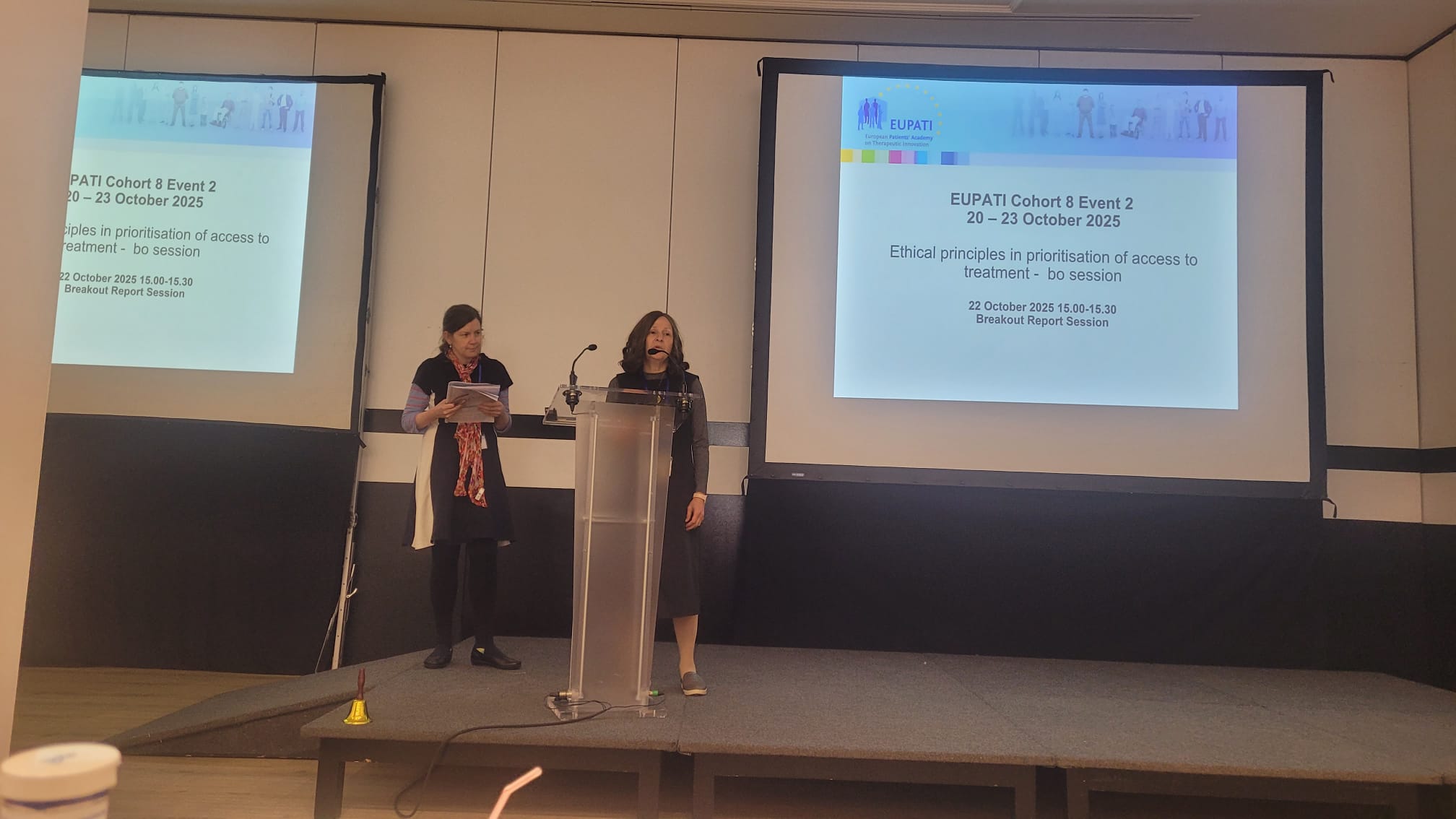
After completing the EUPATI Fellowship, I returned to my work with a renewed sense of strength, clarity, and purpose. The programme gave me tools, but more than that—it reminded me why I do this work. I felt a deep desire to amplify the voices of patients living with atopic dermatitis and to bring this understanding into our small but dedicated team at Kumi Uri – the Israeli Association for Atopic Dermatitis.
Not long after graduating, I had a special opportunity to put these insights into action. Together with GA²P² (Global Allergy & Airways Patient Platform) and leading dermatologists in Israel, we created the first “Atopic Academy”—an educational initiative for young dermatologists and family physicians. The purpose of the academy was to raise awareness of new treatment approaches and improve the accuracy and confidence of clinicians when diagnosing and managing atopic dermatitis.
During the academy conference, I was asked (!) to give a lecture. Thanks to the confidence I gained through EUPATI, I chose to bring into this professional setting something often missing: the patient voice. I presented findings from a 27-country survey conducted by GlobalSkin in partnership with La Roche-Posay, which explored the emotional and physical impact of atopic dermatitis and scarring over a lifetime. Sharing these insights added a human layer to the clinical discussions, and many participants expressed how meaningful it was to hear directly about lived experiences alongside scientific updates.
Another important moment came after a meeting held by Eli Lilly for patient organisations. Learning about their early-stage research for a new AD therapy, I approached their team—confidently, as a newly graduated EUPATI Fellow—to express our interest in contributing to meaningful, responsible patient involvement. Their positive response reinforced how much the fellowship strengthened my ability to engage with industry partners.
EUPATI gave me not only knowledge, but confidence and courage. It empowered me to bring the patient perspective into new spaces, build bridges across sectors, and represent our community with depth, clarity, and heart. I am truly grateful for this journey and everything it continues to inspire.
In the words of EUPATI Fellow Shulamit Burstein – Cohort 8